






Motorcycle modifications and insurance: what riders need to declare
Motorcycle customisation can improve comfort, safety, touring capability or performance, but it can also change how an insurer assesses your machine. A modification is not merely a cosmetic choice when it affects the motorcycle’s value, power, handling, braking, visibility or theft appeal. Before ordering parts or booking workshop time, you should understand how motorcycle insurance disclosure applies to your planned work.
Modifications can change the risk assessed by your insurer
Insurers price motorcycle cover around a declared model, standard specification, rider profile and intended use. Once you alter that specification, the original rating may no longer reflect the motorcycle on the road. A higher-value bike can cost more to replace after theft, while extra performance can affect accident risk and repair costs.
For policy-focused guidance, riders seeking “Infos assurance moto” can consult motorcycle insurance info. Motorcycle policies may distinguish between factory options, dealer-fitted accessories and independently fitted aftermarket components. Cover can also depend on whether accessories are declared separately, whether they are permanently attached, and whether their value exceeds a policy limit. You should ask your insurer how it treats modifications before work begins, rather than assuming a part will be covered automatically.
Not every change has the same effect. A lockable top box may mainly alter the motorcycle’s insured value, while a revised suspension setup can affect handling and safety. An aftermarket exhaust can raise questions about noise, emissions and homologation. Engine mapping, turbocharging and altered intake systems often receive closer underwriting attention because they change the motorcycle’s performance characteristics.
Safety upgrades and performance parts need different checks
Some motorcycle safety upgrades are designed to reduce risk. Better-quality tyres, approved auxiliary lights, upgraded brake components or professionally installed suspension parts may offer practical benefits. Yet safety intent does not remove the need for disclosure. A non-standard braking system, for example, may affect repair methods, spare-part availability and the insurer’s view of the bike’s specification.
Performance modifications normally call for especially clear communication. Changes to horsepower, torque delivery, gearing or top speed can affect premium pricing, policy eligibility and, in some cases, the type of cover available. The same applies to components that change the motorcycle’s road behaviour, including lowered suspension, altered wheel sizes and race-oriented tyres.
| Modification category | Typical insurance consideration | Documentation to retain |
|---|---|---|
| Luggage, panniers and top boxes | Added accessory value and theft exposure | Purchase invoice, fitting receipt, declared value |
| Auxiliary lighting | Road legality, electrical installation and visibility | Approval markings, wiring details, installer record |
| Suspension upgrades | Handling, ride height and repair cost | Part specification, setup sheet, workshop invoice |
| Exhaust systems | Noise, emissions and homologation status | Homologation certificate, invoice, photographs |
| ECU tuning and engine work | Increased performance and non-standard mechanical risk | Dyno report, tuning record, parts list |
| Brake upgrades | Safety-system compatibility and specialist repair needs | Component approval, fitting record, service documentation |
Where local regulations require approved parts, retain the relevant marks, certificates and conformity documents. A part that is legal for track use is not necessarily legal for public roads. Your insurer may also decline a claim connected to an undeclared or unlawful alteration, depending on the policy wording and applicable law.
Sound fabrication supports safer and more defensible custom work
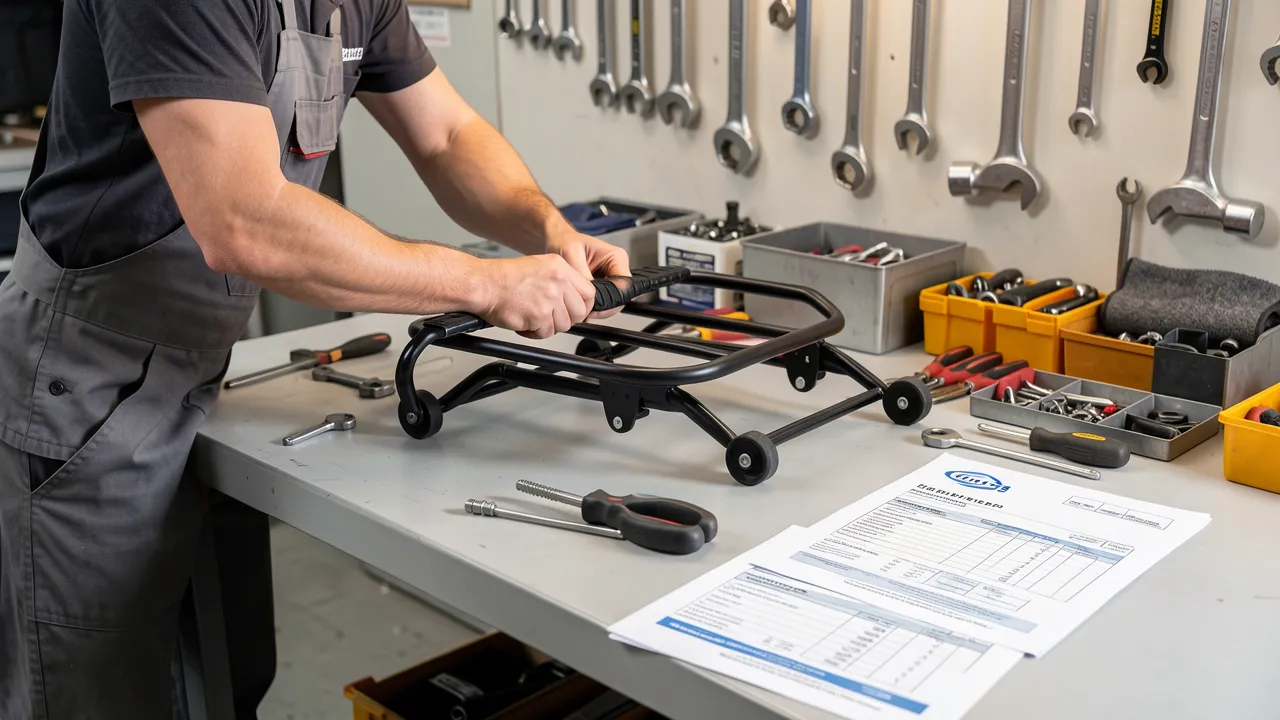
Custom brackets, luggage mounts, crash protection, subframes and lighting supports should be treated as engineered components, not improvised additions. Material choice, load paths, weld quality, corrosion resistance and vibration control all affect reliability. A poorly designed pannier rack can fatigue at mounting points, while an unsuitable metal fastener can corrode or loosen under repeated vibration.
A professional fabricator or workshop should assess compatibility with the motorcycle’s frame, electrical system and weight limits. For structural work, records should identify the materials used, the method of fabrication and any relevant load rating. This approach supports both road safety and a clearer conversation with an insurer if questions arise after a claim.
Photographs taken before, during and after installation can be useful. They provide evidence of the component’s condition, mounting method and overall finish. Keep these images with invoices, specification sheets and communications with the insurer.
Accurate records protect the value of your motorcycle
An insurer cannot properly assess an undisclosed modification, and a claims handler cannot easily value parts that have no paper trail. Keep a dedicated file for aftermarket motorcycle parts, whether you fit them yourself or use a specialist workshop.
Your records should include original purchase invoices, proof of professional installation, manufacturer specifications, approval certificates and photographs. If a component was custom-made, ask for a written description of the work, materials and labour cost. This is particularly useful for bespoke luggage systems, fabricated guards, custom paint, upgraded suspension and electronics.
You should also confirm whether the policy covers modifications at their replacement value or only up to a stated accessories limit. A standard policy may include a modest allowance for accessories, which may be insufficient for a touring motorcycle fitted with premium luggage, navigation equipment, security devices and custom protective hardware.
Protect your motorcycle insurance before you modify
Before fitting a component, use this practical checklist to reduce uncertainty:
- Tell your insurer about any change affecting value, performance or safety-related systems.
- Ask whether the modification changes your premium, excess, cover limits or policy terms.
- Check that the part is legal for road use in your jurisdiction and suitable for your motorcycle model.
- Retain invoices, approval documents, fitting records and clear photographs.
- Use competent installers for electrical, structural, braking, suspension and engine work.
- Update your declared value when accessories or custom fabrication materially increase the motorcycle’s replacement cost.
- Obtain written confirmation from your insurer when a modification has been accepted.
A well-planned modification can make riding more comfortable, safer and more personal. The strongest position is to combine quality engineering with transparent disclosure. By checking policy terms before the work is carried out, you give yourself a clearer route to lawful riding and more reliable insurance protection.