






Choosing foundations for telecom tower installations
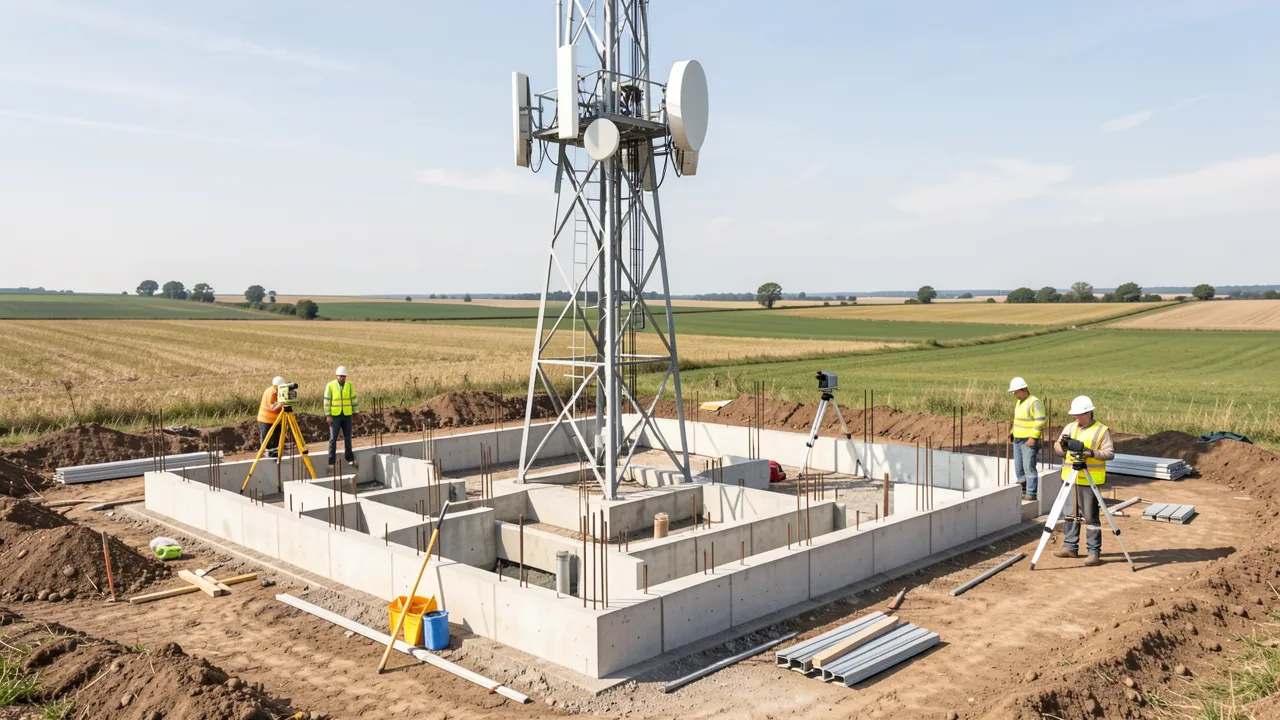
Choosing foundations for telecom tower installations begins with more than selecting a concrete base. The foundation must transfer wind, equipment, tower and maintenance loads safely into the ground throughout its service life. Soil conditions, tower geometry, access limits and local planning requirements all influence the final choice. When you assess these factors early, you can reduce redesigns, programme delays and unexpected groundworks costs.
Start with a ground and load assessment
A reliable foundation design depends on accurate information about both the structure and the site. The tower supplier should provide load reactions for each leg or base connection, including compression, uplift and horizontal shear. These values need to account for the tower height, antenna configuration, feeder cables, platforms, future equipment allowances and the governing wind condition.
Wind loading often drives the design of telecom foundations. A lattice tower may apply substantial uplift to one or more legs when wind acts from a particular direction. Monopoles can generate large overturning moments at a single base. The design must therefore consider the full load combination rather than only the tower’s self-weight.
Ground investigation is equally significant. You should obtain information on soil strength, bearing capacity, groundwater level, rock depth, contamination and the presence of made ground. Trial pits, boreholes, dynamic probing and laboratory tests can all support the geotechnical assessment. On constrained urban sites, existing services and basement structures may also limit excavation depth or foundation width.
Tower load data should be reviewed alongside the wider installation strategy. Guidance on Telecom masts and towers for UK sites can help you understand how wind exposure, structural form and site location affect the loads that reach the foundation.
Match foundation type to site constraints
The most suitable solution depends on how the tower interacts with the soil and how the site can be built. A spread footing foundation is commonly used for lattice towers where competent bearing soils are available near the surface. Each tower leg may sit on an individual reinforced concrete pad, sometimes connected by ground beams to improve stability and control differential movement.
For a self-supporting tower, pad-and-chimney foundations can provide a practical arrangement. The reinforced concrete pad spreads loads into the soil, while the chimney or pedestal raises the steel connection above finished ground level. This can simplify drainage and protect the tower base from standing water.
A monopole often uses a large circular or square reinforced concrete base with holding-down bolts. The required size can be substantial because the foundation resists overturning through its weight, soil pressure and embedded depth. Where excavation space is restricted, a deeper foundation may be preferable to a very wide one.
Piled foundations are appropriate when weak near-surface soils cannot support conventional pads, when settlement risk is high, or when rock and dense strata lie at greater depth. Bored piles, driven piles or micropiles may transfer tower forces to stronger ground. Pile caps then distribute loads between the piles and the tower connection points.
On rooftops, the structural issue changes. The building frame, not the natural ground, carries the mast loads. You need a verified load path through roof beams, columns and the existing structure. For these projects, Rooftop antenna mounting best practices for flat roofs offers useful context on support frames, ballasted systems and roof protection.
Design for durability and construction control
Foundation drawings should specify dimensions, reinforcement, concrete grade, bolt assemblies, cover requirements and tolerances. Small errors in holding-down bolt positions can prevent a tower section from fitting correctly, causing costly site modifications. A setting-out template and pre-pour inspection are sensible controls.
Concrete durability requires attention to the local environment. Sulphate-bearing soils, coastal exposure, freeze-thaw conditions and persistent groundwater can affect concrete specification and reinforcement protection. The foundation should also include suitable drainage so water does not collect around steelwork or cable entries.
You should plan for installation access before finalising the foundation. Concrete wagons, drilling rigs, cranes and excavation plant all need safe routes and working space. Remote compounds may require temporary trackways, while city-centre sites may demand smaller equipment, timed deliveries and restricted excavation methods.
Fabrication quality matters as much as the concrete work. Base plates, anchor cages, tower stub sections and connection details must align with the structural design. The requirements discussed in Uk steel fabrication standards for telecom structures can support clearer specifications for fabricated steel components and quality records.
Plan for inspection before the pour
Before concrete is placed, verify excavation depth, formation condition, reinforcement spacing, concrete cover, earthing arrangements and anchor bolt geometry. Photographs, survey records and inspection sign-off create a useful record for handover and later maintenance.
After curing, confirm the foundation level and bolt positions with a survey. You should not erect the tower until the concrete has reached the specified strength and all connection details have been checked.
Use this checklist before approving the foundation
Before you commit to a design and construction programme, confirm that the following points have been addressed:
- Tower loads include future antenna and equipment allowances.
- Ground investigation data reflects the actual tower location.
- The chosen foundation resists bearing pressure, uplift, shear and overturning.
- Existing underground services and drainage routes have been surveyed.
- Concrete, reinforcement and steelwork specifications suit the exposure conditions.
- Anchor bolt templates, surveys and pre-pour inspections are included in the quality plan.
- Construction access, lifting operations and spoil removal have been planned.
- Earthing and lightning protection interfaces are coordinated with the civil works.
A well-chosen telecom tower foundation protects long-term performance
A foundation is not simply a buried concrete element. It is the connection between a telecom structure and the ground conditions that govern its stability. By combining sound geotechnical information, accurate tower loads, suitable foundation geometry and disciplined site controls, you can create an installation that remains secure, maintainable and ready for future network upgrades.